
How to Choose Beard Dye When Your Beard Is Going Grey
Share
When a beard starts going grey, most men instinctively look at the grey.
For choosing colour, look at what hasn't gone grey.
The brown, black or lighter hairs still growing through your beard are usually your best guide to the shade that will look believable on your face.
That one change in thinking can prevent one of the most common beard-colouring mistakes: going far too dark.
Do not choose your shade based on the grey hairs
Imagine a beard that is:
-
60% grey
-
40% naturally dark brown
The correct starting question is not:
“What colour covers grey the strongest?”
It is:
“What colour are the dark hairs that are still there?”
If those hairs are naturally dark brown, Dark Brown is normally a more logical starting point than Midnight Black.
Grey percentage affects how the finished beard may look.
It should not automatically determine the shade.
For our broader comparison of all four colours, see Best Beard Dye Colours for 2026.
Why going too dark can make beard dye obvious
A beard sits directly against the skin.
That makes excessive contrast easy to see.
If a naturally brown beard suddenly becomes uniform black, particularly when the hair on the head is brown or greying, the result can look much more dramatic than expected.
That may be exactly what some men want.
But if your goal is natural-looking grey reduction, the better approach is normally to remain close to your existing facial-hair colour.
Bohemian Kings is built around a simple idea:
look sharper, not different.
Use facial hair, not head hair, as your reference
Your beard does not have to match your scalp exactly.
Plenty of men naturally have facial hair that is:
-
darker than their head hair
-
lighter than their head hair
-
warmer or redder
-
mixed in colour
So stand in good natural light and look closely at the non-grey beard hairs around the cheeks, moustache and chin.
Those hairs are your starting point.
A photograph taken outdoors in indirect daylight can be more useful than judging the beard under warm bathroom lighting.
If your natural beard is light brown
Consider Light Brown.
This makes most sense where the remaining facial hair is genuinely lighter brown, sandy or towards dark blonde.
The goal is to reduce the visual contrast of grey without suddenly placing a deep brown block of colour against a naturally lighter beard.
Explore Light Brown Beard Dye.
If your natural beard is medium brown
Consider Brown.
This sits between Light Brown and Dark Brown and can suit men whose remaining beard hair has a clear mid-brown appearance.
It is particularly relevant when Dark Brown would create too much contrast but Light Brown would not provide the depth you want.
If your natural beard is dark brown
Consider Dark Brown.
This is the logical starting point for men whose remaining natural beard is clearly brown but deep in tone.
A dark-brown shade can reduce the contrast produced by white and grey hairs without automatically pushing the entire beard into black.
If your beard is naturally black
That is where Midnight Black makes sense.
Midnight Black is intended for men whose remaining natural facial hair is already black or extremely dark.
It should not be selected simply because black sounds like the strongest option for covering grey.
If your natural beard is actually brown, Dark Brown may produce a more believable transition.
Explore Midnight Black Beard Dye.
What if your beard is almost completely white?
This is where shade selection becomes more difficult because there may be very little original colour left to use as a reference.
Look at:
-
remaining pigmented beard hairs
-
earlier photographs of your beard
-
moustache or sideburn areas that still contain pigment
-
your natural facial-hair colour before greying
Do not automatically recreate the darkest colour you remember from 15 or 20 years ago.
Your complexion, head hair and overall appearance may have changed too.
A slightly softer result can often integrate more naturally with the face you have now.
What if you want to keep some grey?
Then you are not actually trying to recreate your old beard.
You are trying to manage contrast.
That is a different goal.
A salt-and-pepper result can look deliberate and mature when enough grey remains visible to create natural variation.
Rather than chasing complete uniformity, colour can be used to make the lightest areas less dominant.
Our guide to colouring a grey beard naturally covers this approach in more detail.
Your first application should teach you something
Do not expect the first application to answer every question about your beard.
It gives you information:
-
how quickly your beard takes colour
-
which areas are most resistant
-
how your chosen shade looks against your skin
-
how much grey remains visible
-
how the colour develops over the next 24–48 hours
That information is useful.
It is far easier to build a slightly softer result than to undo a beard that has immediately been taken several shades too dark.
Do not judge plant-based colour immediately after rinsing
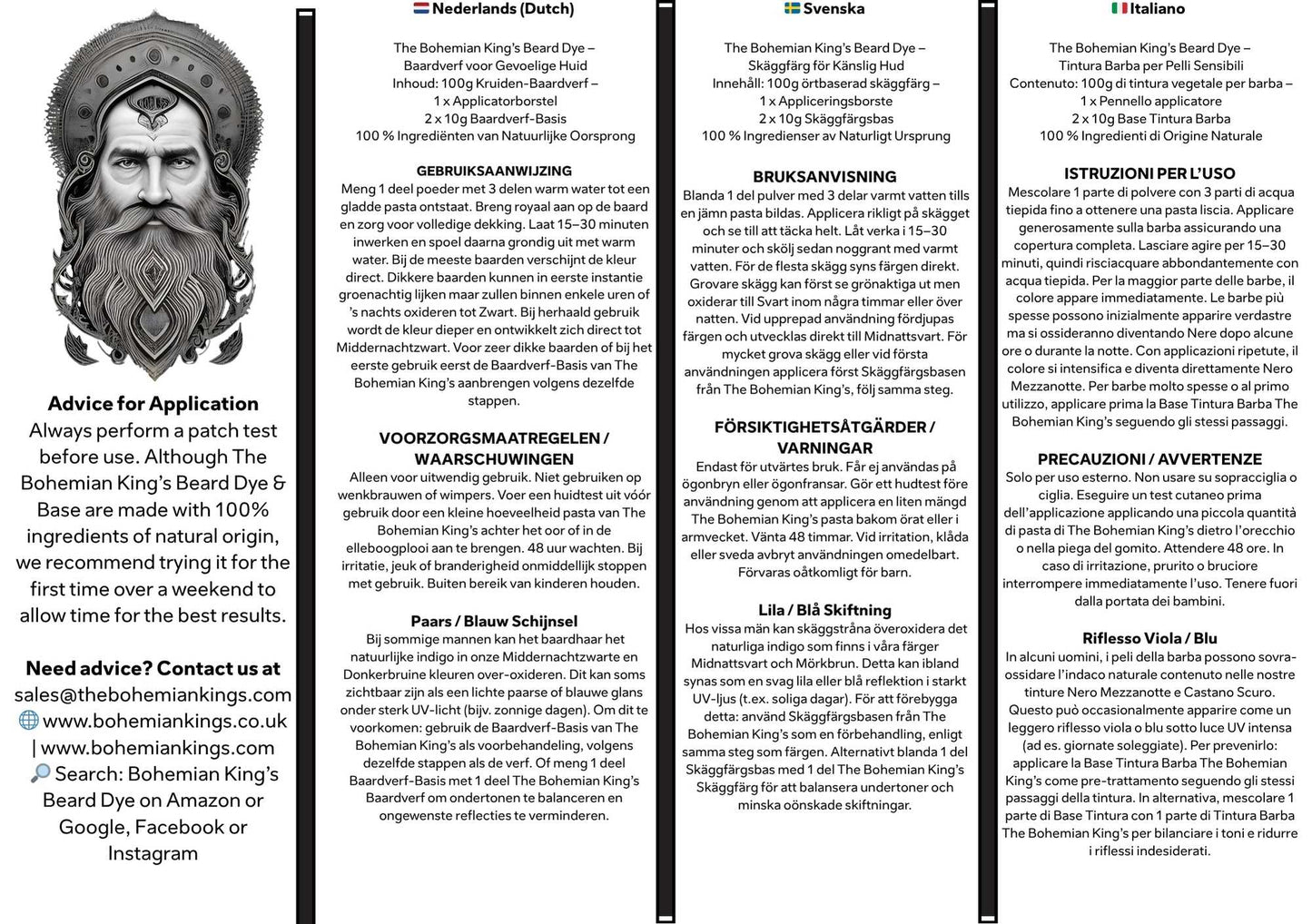
With The Bohemian King’s system, colour can continue to settle and develop after application.
Give the result approximately 24–48 hours before deciding whether the shade is wrong or whether another application is needed.
During that period follow the supplied aftercare guidance.
You can find the complete process in our beard dye application guide.
The simplest shade rule
If you remember only one thing from this article, make it this:
Match the hairs you still have — not the grey hairs you want to hide.
That gives you a much better starting point for natural-looking beard colour.
Quick starting guide
Naturally light-brown facial hair: Light Brown
Naturally medium-brown facial hair: Brown
Naturally dark-brown facial hair: Dark Brown
Naturally black facial hair: Midnight Black
This is guidance rather than a guarantee. Results vary depending on the original beard colour, proportion of grey or white hair, texture, preparation, application and colour development.
Always complete the required patch test and follow the instructions supplied with your product.
Related guides
Frequently asked questions
Should I use black beard dye to cover grey?
Only if your natural facial hair is black or extremely dark and black is the result you actually want. Grey percentage alone is not a reason to select black.
Should beard dye match my head hair?
Not necessarily. Facial hair can naturally differ from scalp hair. Your remaining non-grey beard hairs are generally the more useful reference.
Is Dark Brown better for grey hair than Brown?
Neither shade is universally better. Dark Brown is intended for naturally darker brown beards while Brown better matches medium-brown facial hair.
Should I go darker if the first application looks too light?
Allow the colour to complete its normal development period first. With The Bohemian King’s plant-based system, the shade may continue developing after rinsing.