
Why Grey Beard Hair Can Be Harder to Colour
You mix your beard colour correctly, apply it carefully and give it the recommended time.
Most of the beard looks good.
Then a handful of grey or white hairs around the chin or moustache seem to have ignored the whole operation.
If that sounds familiar, you are not necessarily doing anything wrong.
Grey and white beard hair can behave differently from the darker hairs around it, and the difference becomes particularly noticeable when a beard contains a mixture of pigmented, grey and white fibres.
Understanding that difference makes it much easier to approach beard colouring realistically.
Grey hair is not identical from one man to another
One of the easiest mistakes is treating “grey hair” as a single hair type.
It isn't.
Scientific research comparing pigmented and non-pigmented hair fibres has found differences in properties such as mechanical behaviour and moisture uptake in some individuals. Researchers have also noted that grey fibres are often perceived as drier, wilder or less manageable.
Importantly, those differences are not identical across everyone.
That fits what we see with beard colour in practice: one man's grey beard can take colour relatively easily, while another man's white or wiry hairs may need considerably more care and preparation.
So “grey hair is resistant” is too simplistic.
A better way of putting it is:
grey and white hairs can behave differently from the remaining pigmented hairs, and the degree of difference varies from beard to beard.
Grey beards are usually a mixture of different hairs
A salt-and-pepper beard can contain:
-
naturally dark hairs
-
partially pigmented hairs
-
completely white hairs
-
finer hairs
-
coarse or wiry hairs
-
different textures across the chin, cheeks and moustache
That makes colouring a beard very different from painting one uniform surface.
One section can appear darker while another remains lighter simply because the hairs underneath were different before the colour was applied.
This is one reason we encourage men to think in terms of reducing the contrast created by grey, rather than expecting every individual hair to become exactly the same colour.
If you are deciding whether you want full-looking colour or simply a softer salt-and-pepper result, read our guide to colouring a grey beard naturally.

White hairs make colour differences easier to see
A white hair has little or no visible natural pigment.
That means any colour deposited onto it can appear more obvious than colour applied over an already brown or black hair.
Imagine applying a transparent colour over white paper and then applying the same colour over brown paper.
You would not expect both to look identical.
A similar visual principle applies when colouring a mixed beard.
Your remaining natural beard colour contributes to the final appearance, while very pale or white hairs provide a much lighter starting point.
That is why the same product can produce slightly different-looking tones across the same beard.
Texture matters too
Grey beard hair is often described as coarse or wiry, although not every grey hair has these characteristics.
Research into ageing hair has found differences between pigmented and non-pigmented fibres, while also showing substantial variation between individuals.
That is important because the physical condition of a beard affects how easily you can distribute a plant-powder paste through it.
A dense, wiry moustache, for example, may simply be more difficult to saturate evenly than softer hair on the cheeks.
Poor saturation can then look like poor colour performance.
The solution is not automatically to leave the dye on for longer.
Better preparation and more careful application usually make more sense than simply increasing the processing time.
Product build-up can make an uneven result worse
Before colouring, look at what has been on your beard.
Heavy beard oils, balms, waxes and styling products can leave residue on the hair.
If one section of the beard contains more residue than another, the colouring paste may not contact every hair in the same way.
For The Bohemian King’s system, start with the beard prepared according to the instructions and avoid coating the hair with oils or balms immediately before colouring.
Our complete beard dye application guide explains the process step by step.
Water temperature matters with plant-powder colour
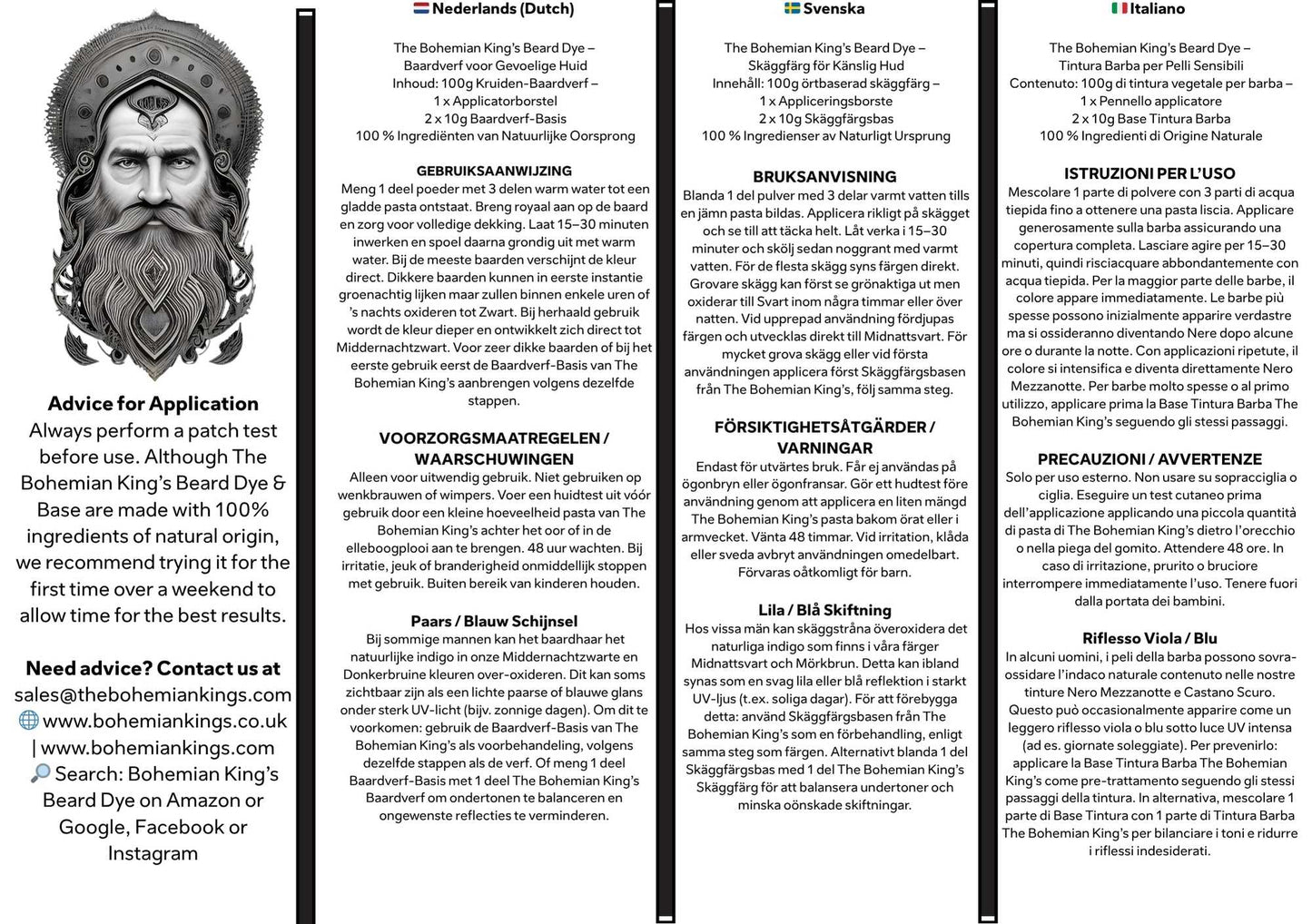
The Bohemian King’s beard colour should be mixed with warm water — never boiling water.
A practical target is approximately 35–70°C.
Extremely hot or boiling water is unnecessary and can alter the way plant powders behave.
The objective is a smooth, workable paste that can be distributed properly through the beard.
Follow the mixing ratio and timing supplied with your product rather than trying to increase colour intensity by using boiling water.
Why preparation becomes more important on resistant areas
The Bohemian King’s beard dye range includes Beard Dye Colour Base as part of the colour ritual.
Its role is preparation.
For men with coarse, resistant or heavily grey areas, following the Base stage carefully can help create a more controlled starting point before the main colour is applied.
That does not mean every grey beard will behave identically, and it does not guarantee that every white hair will finish at precisely the same depth.
It means the preparation stage should not be treated as an afterthought when you already know your beard contains resistant areas.
Don't respond to resistant grey by automatically choosing black
This is another common mistake.
A man sees several stubborn grey hairs after using brown colour and concludes:
“I need black.”
Not necessarily.
Shade and colour uptake are different questions.
If your remaining natural facial hair is brown, switching to black may simply produce an unnaturally dark beard while the resistant hairs still behave differently.
Your natural non-grey hairs should remain your main reference when choosing the shade.
For a fuller comparison of Light Brown, Brown, Dark Brown and Midnight Black, see our beard dye colour guide.
A second application can sometimes build the result
With plant-based colour, the first application does not have to be treated as an all-or-nothing event.
Some coarse or heavily grey beards may need another application to develop the desired depth.
However, do not immediately reapply colour simply because the beard looks slightly different after rinsing.
The Bohemian King’s colour can continue developing over the following 24–48 hours.
Allow the result to settle before deciding whether another application is appropriate.
Always follow the product instructions and complete the required patch test before use.
What if only the moustache or chin resists colour?
That is not unusual.
Different areas of the beard can have different:
-
hair density
-
proportions of white hair
-
texture
-
exposure to grooming products
-
hair thickness
Apply the product carefully through the resistant area and make sure the hair itself is properly coated rather than simply covering the surface of the beard.
If you are using The Bohemian King’s for the first time, our beginner's guide to beard colouring explains what to expect from the first application.
The important takeaway
Grey beard colouring is not about overpowering the hair.
It is about understanding the beard you actually have.
If part of your beard colours differently from another part, look first at:
-
how much white hair is present
-
the texture of those hairs
-
whether the beard was clean and free from heavy product build-up
-
whether the paste was mixed and applied evenly
-
whether you allowed the result time to develop
-
whether your chosen shade matches your remaining natural facial hair
Do those things before assuming that you simply need a darker product.
The goal should be a beard that looks balanced and believable — not one uniform block of colour.
Related guides
Frequently asked questions
Why won't beard dye cover some grey hairs?
Grey and white hairs can differ in texture and starting colour from the pigmented hairs around them. Application, preparation, product residue, beard texture and the proportion of white hair can all affect the visible result.
Should I leave beard dye on longer if my grey is resistant?
Follow the timing supplied with the product. Longer does not automatically mean better and can create an unnecessarily dark or unbalanced result.
Should I choose a darker shade for resistant grey hair?
Not automatically. Choose your shade primarily from your remaining natural facial hair rather than the amount of grey you want to cover.
Can grey beard colour develop after rinsing?
With The Bohemian King’s plant-based colour system, the shade may continue to develop and settle over approximately 24–48 hours. Judge the result after that development period rather than immediately after rinsing.