
Salt-and-Pepper Beard Colour: How to Reduce Grey Without Losing Your Natural Look
Grey in a beard does not automatically need to disappear.
For plenty of men, the best result sits somewhere between leaving every grey hair untouched and colouring the beard into one perfectly uniform shade.
That middle ground is the salt-and-pepper beard: mature, natural and deliberately well kept.
The trick is knowing what you are actually trying to achieve before you open the dye.
Should you cover every grey hair in your beard?
Not necessarily.
If your beard is naturally varied — perhaps dark brown around the moustache and chin, lighter at the sides and increasingly grey through the jaw — making every hair identical can sometimes make the beard look less natural rather than more natural.
A better objective can be to reduce the contrast between the whitest hairs and your naturally pigmented beard.
That is an important distinction.
You are not necessarily trying to hide your age. You are trying to make your beard look more considered.
For men who want to look sharper, not different.
Choose beard colour from the hair that has not turned grey
One of the easiest shade mistakes is looking at the amount of grey in your beard and deciding you need a very dark colour to compensate.
Instead, look closely at the natural non-grey hairs that remain in your beard.
If those hairs are deep brown, Dark Brown is normally the logical direction. If they are medium brown, Natural Brown may produce a softer transition. Midnight Black is intended for naturally black or extremely dark beard hair rather than simply being the strongest option available.
That distinction matters because going darker than your natural beard can create precisely the heavily dyed appearance many men are trying to avoid.
The current Bohemian King’s shade system follows the same principle: choose according to your natural non-grey beard colour rather than the shade you would simply like to become. Bohemian Kings EU

Why can grey beard hair be harder to colour?
Grey and white beard hairs can behave differently from the rest of the beard.
They are frequently the hairs you notice most because they can be coarse, wiry or resistant. You may therefore find that the darker hair develops colour readily while individual white hairs remain lighter.
That does not automatically mean the first application has failed.
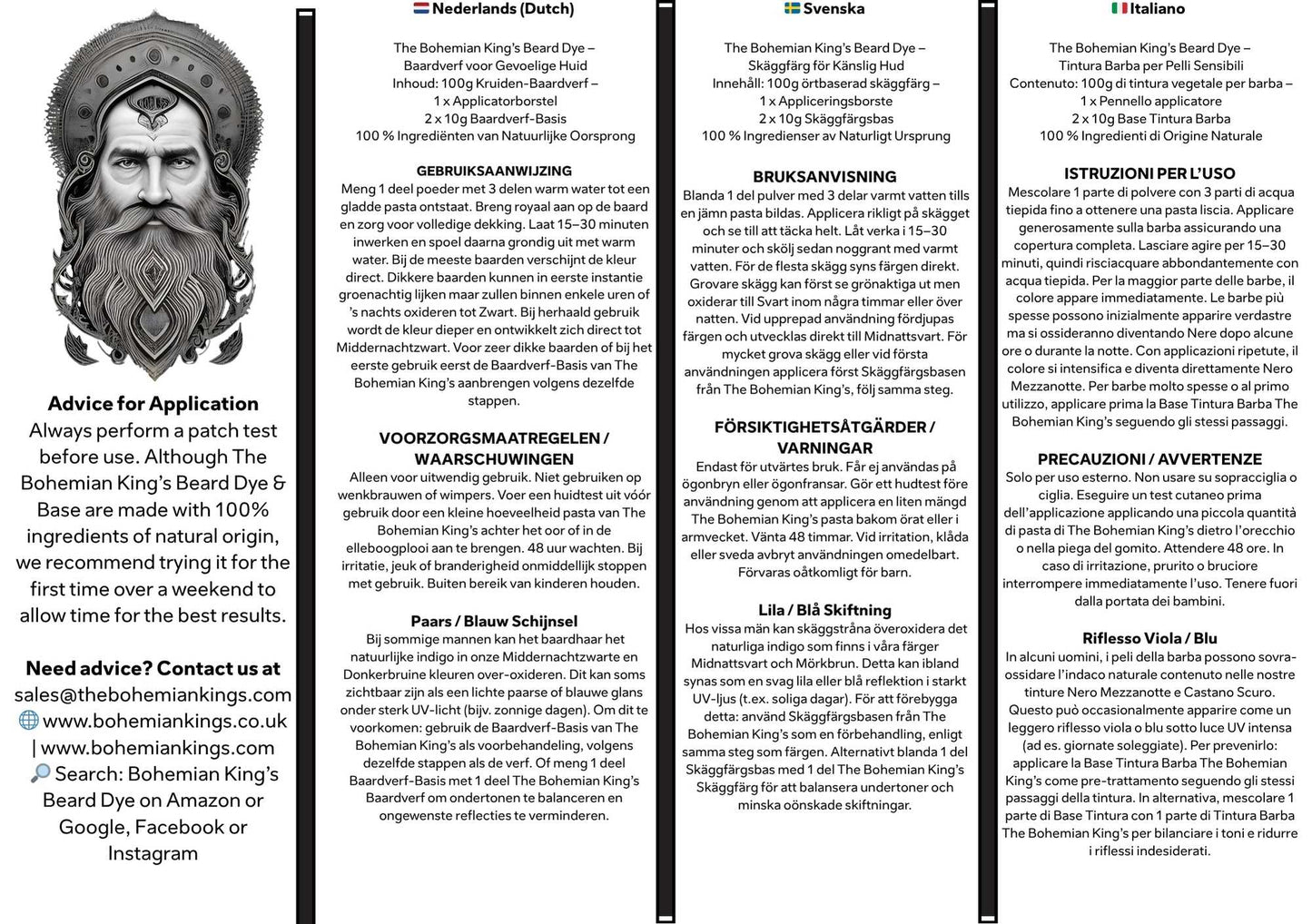
With plant-powder colour, it is worth allowing the colour time to develop before deciding what to do next. Bohemian King’s advises allowing up to 24–48 hours for the final shade to develop after rinsing. Resistant grey or white hairs may sometimes require a further application rather than excessively extending the first application. Bohemian Kings EU
This is also where the included Beard Dye Colour Base can be useful as part of the preparation routine, particularly for coarse or resistant areas.
A slightly uneven result can actually look more natural
This sounds counter-intuitive, but natural beards are not normally one colour.
Look closely and you will often find darker hairs, lighter hairs, warmer hairs and greys all living together.
That variation gives a beard depth.
So if your goal is a convincing salt-and-pepper finish, judge the overall appearance of the beard, not whether every individual white hair has become exactly the same shade.
There is a difference between incomplete colour and natural colour variation.
The latter can be the better-looking result.
Beard length matters
Bohemian King’s recommends colouring beard and moustache hair once it has reached approximately 1 cm or longer.
Very short stubble gives plant colour much less hair to work with and can make consistent application more difficult. Bohemian Kings EU
If you currently keep a very short beard and intend to colour it, allowing a little more growth before your first application may give you a much better starting point.
Do not judge your beard immediately after rinsing
Plant-based beard colour is not necessarily at its finished shade the moment the paste comes off.
Rinse thoroughly with warm water, pat the beard dry, and give the colour time to develop. Bohemian King’s recommends avoiding shampoo for 24 hours and beard oils for 36 hours after application. Bohemian Kings EU
Your bathroom mirror ten minutes after rinsing is not the final verdict.
Which Bohemian King’s shade suits a salt-and-pepper beard?
For naturally deep brown beards, Dark Brown is often the most obvious starting point.
For medium-brown beards or men looking for a softer transition between pigmented and grey hairs, Natural Brown may be the better direction.
Men with naturally black beard hair should consider Midnight Black, while naturally lighter brown or sandy facial hair is better matched to Light Brown.
The principle stays the same: match what nature has already given you rather than trying to manufacture a completely different beard.
Frequently asked questions
Can I leave some grey showing?
Absolutely. There is no requirement to make every grey hair disappear. If your objective is a salt-and-pepper appearance, reducing the contrast between the grey and naturally darker hair can be enough.
Why are some white hairs still lighter after colouring?
Coarse and resistant grey or white hairs can take colour differently. Allow the colour to develop fully before judging the result. Some beards may benefit from a subsequent application.
Should I use black to get better grey coverage?
Not simply because you have a lot of grey. Choose a shade that matches your naturally pigmented beard hair. A shade that is unnecessarily dark can look less natural.
Do I still need a patch test?
Yes. A 48-hour patch test before every application remains important even when a product is plant-based or formulated without PPD. Bohemian Kings EU
The Bohemian King’s approach
Getting older does not mean choosing between ignoring your beard completely and trying to make it look twenty years younger.
There is another option.
Keep the character. Reduce the contrast. Sharpen what is already there.
The Beard Colour Ritual for Men Who’ve Lived.
Live internal links: EU Dark Brown Beard Dye · EU Natural Brown Beard Dye · How to Apply · Existing Grey Beard Guide · Shop the EU Beard Dye Range