
Beard Dye Burns and Rashes: How to Reduce the Risk of a Reaction
Share
Colouring your beard should not involve guesswork.
Hair and beard colour products contain ingredients designed to change the appearance of the hair, and some people can experience irritation or an allergic reaction to particular ingredients.
One ingredient that receives considerable attention is p-phenylenediamine, usually shortened to PPD. The NHS explains that many permanent and some semi-permanent hair dyes contain PPD and that it can irritate the skin or cause allergic reactions in some people. nhs.uk
But there is an important point that often gets lost online:
PPD is not the only ingredient to which somebody could react, and PPD-free does not mean reaction-free.
Understanding what is in a product, carrying out the required patch test and following the instructions properly are more useful than relying on broad claims such as “natural”, “gentle” or “chemical-free”.
Explore Bohemian King’s beard colour range
What does a beard dye reaction look like?
People often describe an uncomfortable reaction to hair or beard dye as a “burn”, but burning or stinging can be symptoms of either irritation or an allergic reaction.
According to the NHS, possible symptoms of a hair-dye reaction include stinging or burning, itching, dryness, tightness, soreness and blistering. Symptoms do not always appear immediately and can take up to 72 hours to develop. Severe allergic reactions are uncommon, but they can occur. nhs.uk
If you experience swelling of the lips, mouth, tongue or throat, difficulty breathing, or other signs of a serious allergic reaction, seek urgent medical help.
For less severe but persistent or worsening symptoms, speak to an appropriate healthcare professional.
What is PPD?
PPD — p-phenylenediamine or paraphenylenediamine — is widely used in permanent oxidative hair colouring.
DermNet explains that PPD requires oxidation to become a dye and that the partially oxidised form can cause allergic contact dermatitis in susceptible people. DermNet also notes that darker shades of conventional hair dye can contain higher concentrations of PPD than lighter shades, although individual product formulations vary. DermNet®
That is why men who have previously experienced problems with conventional beard or hair colour often start reading ingredient labels more carefully.
If you specifically want to avoid PPD, look at the ingredient information rather than relying solely on the front of the pack.
What about “black henna”?
This is an important distinction.
Traditional henna and so-called “black henna” temporary tattoos are not the same thing.
DermNet explains that PPD is sometimes added to temporary henna tattoo preparations to create a darker, black appearance. Exposure to these preparations can cause PPD sensitisation, which may increase the likelihood of a later reaction to products containing PPD. DermNet®
The NHS similarly identifies previous exposure to a black henna tattoo as a factor associated with increased risk of a later PPD reaction. nhs.uk
So the useful question is not simply:
“Does this product contain henna?”
It is:
“What exactly is in the complete formulation?”
That is why ingredient transparency matters.
How can you reduce the risk of a beard dye reaction?
A few basic precautions matter far more than marketing language:
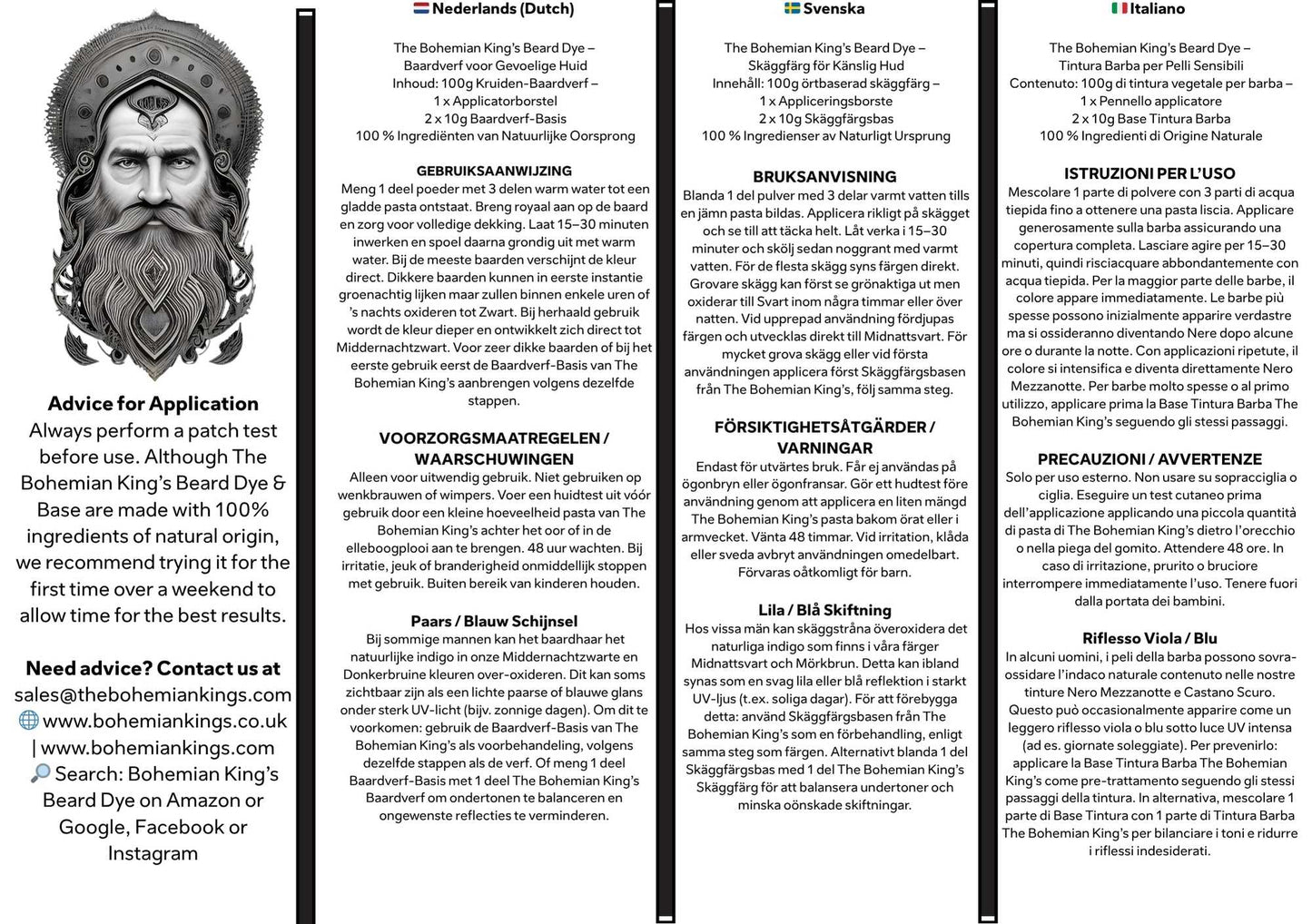
- Carry out the required patch test. For Bohemian King’s, complete the specified patch test at least 48 hours before every application, even if you have used the product previously. The FDA also advises carrying out a skin patch test each time hair dye is used. U.S. Food and Drug Administration
- Read the full ingredient list. If you know that you are allergic or sensitive to a particular ingredient, do not rely on terms such as “natural” or “plant-based” as substitutes for checking the formulation.
- Follow the application instructions. Wear gloves where instructed, use the recommended quantities and do not leave a colour product on longer simply in the hope of achieving a darker result. The NHS and FDA both advise following the supplied instructions and not exceeding recommended application times. nhs.uk
- Do not continue if you experience a reaction. Rinse as directed and seek medical advice where appropriate. Do not keep applying a product in an attempt to “push through” irritation.
- Take previous reactions seriously. If you have experienced a significant reaction to hair dye or a black henna tattoo, consider discussing this with a doctor or dermatologist before experimenting with another colour product. Dermatological patch testing can sometimes help identify the ingredient responsible. nhs.uk
One important limitation is worth understanding: even a negative consumer patch test cannot guarantee that a reaction will never occur. DermNet notes that a negative pre-use test reduces concern but does not guarantee freedom from a later reaction. DermNet®
Does plant-based mean allergy-free?
No.
Plant-based describes the origin or nature of ingredients. It is not a guarantee that every person will tolerate them.
Botanical ingredients contain naturally occurring chemical compounds, and individual sensitivities can occur.
That is why we would not describe a plant-based beard dye as “allergy-free”, “risk-free” or universally “safer”.
Those claims go beyond what the absence of a particular ingredient establishes.
The same principle applies to PPD-free.
PPD-free tells you something specific and useful:
the formulation does not contain PPD.
It should not be interpreted as meaning that no other ingredient could cause sensitivity.
That distinction is both more accurate for customers and more consistent with European cosmetics-claims principles. European Commission
The Bohemian King’s approach to beard colour
The Bohemian King’s beard-colour powders use plant-derived colouring ingredients and are formulated without p-phenylenediamine (PPD) or ammonia.
We developed the range for men looking for a different approach to conventional beard colouring — particularly men who want natural-looking colour rather than a flat, painted-on finish.
But we do not believe that being plant-based removes the need for proper precautions.
Every application still requires a 48-hour patch test.
You should read the full ingredient information, follow the enclosed instructions and stop using the product if you experience an unwanted reaction.
That is more useful than promising something no cosmetic colour product can reasonably promise.
Learn more about Bohemian King’s plant-based beard colour
Why application time matters
More time does not automatically mean better colour.
Grey and white beard hairs can be coarse or resistant, which means some hairs may take colour differently from others.
If resistant hairs need additional colour, follow the recommended application process rather than simply leaving the first application on indefinitely.
Bohemian King’s colour develops progressively, and the final shade can continue to deepen during the 24–48 hours following application. Coarse or resistant white hairs may sometimes benefit from a further application according to the product instructions. Bohemian Kings EU
So give the first result time to develop before deciding what it needs next.
Read the Bohemian King’s application guide
Can PPD-free beard dye still cause a reaction?
Yes.
The absence of PPD removes PPD from the equation, but it does not mean an individual cannot be sensitive to another ingredient.
This is why Bohemian King’s requires a patch test even though its beard-colour formulas are made without PPD or ammonia.
Is henna the same as “black henna”?
No.
Traditional henna comes from Lawsonia inermis. The term “black henna” is often used for temporary tattoo mixtures to which PPD may have been added to produce a very dark stain. These should not be confused with ordinary henna powder. DermNet®
Do darker beard dyes always contain more PPD?
Not necessarily.
DermNet notes that darker conventional oxidative hair-dye shades often contain higher concentrations of PPD, but formulations vary between products and manufacturers. DermNet®
The reliable way to know whether a particular product contains PPD is to check its formulation or ingredient information.
Should I patch test beard dye every time?
For Bohemian King’s, yes — 48 hours before every application.
The FDA also recommends a pre-use skin test each time hair dye is used, while the NHS advises following the testing and safety instructions supplied with the product. nhs.uk
What if I have reacted to beard dye before?
Do not assume that simply changing brands will identify the cause.
Different formulations contain different ingredients. If you have had a significant previous reaction, a healthcare professional or dermatologist can advise you and, where appropriate, investigate potential allergens through professional patch testing. nhs.uk
Choosing your Bohemian King’s shade
Once you have completed the required patch test, choose your colour according to your natural non-grey beard hair, rather than simply choosing the darkest available shade.
For naturally deep-brown beard hair:
For naturally black or very dark beard hair:
For a complete beard-colour routine:
The bottom line
Beard-dye reactions are real, and PPD is a recognised cause of irritation and allergic contact dermatitis in some people. But PPD is not the only possible cause of a cosmetic reaction, and describing any alternative as completely safe would oversimplify the issue. nhs.uk
The sensible approach is straightforward:
Know what is in the product. Patch test before every application. Follow the instructions. Give colour time to develop. And if you have previously experienced a significant reaction, seek appropriate medical advice before trying another colour product.
Bohemian King’s provides a plant-based beard-colour option formulated without PPD or ammonia for men who want a different approach to colouring grey and white facial hair.
For men who want to look sharper, not different.
Beard dye can cause irritation or allergic reactions in some people, particularly where certain hair-colour ingredients such as PPD are involved. Learn what PPD is, why patch testing matters, how plant-based beard colour differs, and what to check before colouring your beard