
Beard Dye and Sensitive Skin: PPD, Patch Tests and Ingredient Questions
If you have sensitive or reactive skin, choosing beard dye deserves more thought than simply looking for the words “natural” or “plant-based.”
Those descriptions tell you something about a formulation.
They do not tell you that a reaction is impossible.
That distinction matters.
What is PPD?
PPD is short for p-phenylenediamine, a colouring ingredient used in many permanent oxidative hair dyes, particularly darker shades.
PPD performs an important function in those products, but it is also associated with irritation and allergic reactions in some people. NHS guidance identifies PPD as a common cause of hair-dye reactions. nhs.uk
Bohemian King’s beard-colour powders are formulated without PPD and without ammonia. Bohemian Kings EU
That tells you exactly what is not in the formulation.
It does not mean “allergy-free.”
Does PPD-free mean safer for everyone?
No.
And this is where cosmetic marketing often becomes less useful than it should be.
Removing one ingredient does not mean nobody can react to any of the remaining ingredients.
Plant-derived materials contain naturally occurring chemical substances too. Henna, indigo and other botanical ingredients should therefore still be treated as cosmetic ingredients, not as a free pass to skip safety instructions.
If you have previously experienced a significant reaction to hair or beard dye, do not assume a completely different product must automatically be suitable simply because it does not contain PPD.
Why is the patch test still important?
Because individual sensitivity can change.
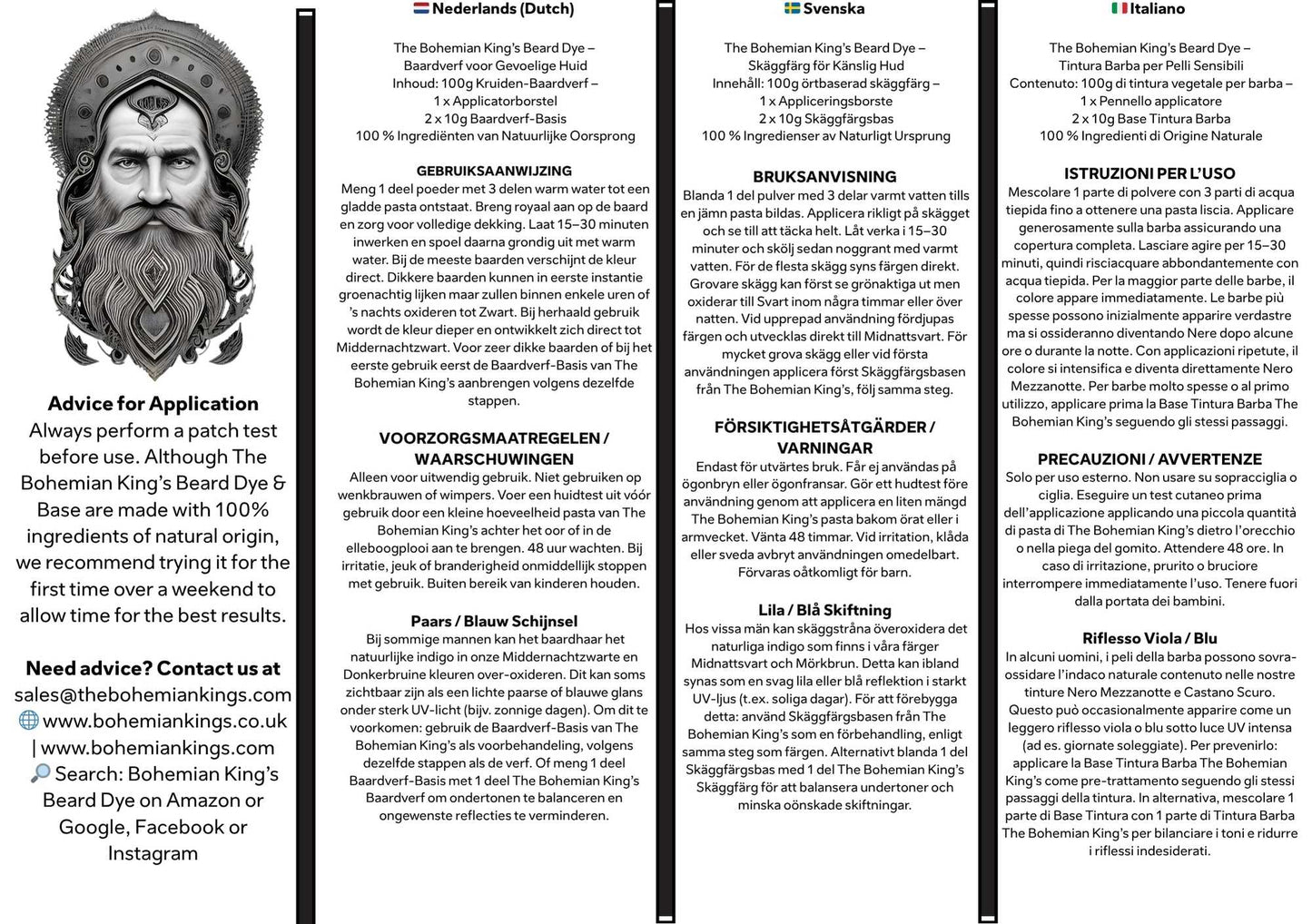
Bohemian King’s requires a 48-hour patch test before every application, including repeat applications. Bohemian Kings EU
Follow the instructions supplied with the product rather than improvising your own testing method.
If the test produces an unwanted reaction, do not proceed with the full beard application.
What should you check before buying beard colour?
Start with the full ingredient list.
Then ask what kind of colouring system the product uses, how long the application takes, whether a developer is required, what safety instructions are provided and whether the manufacturer is clear about the limitations of the product.
A useful product page should tell you more than “natural” or “gentle”.
It should help you make an informed decision.

Plant-based beard colour works differently
Bohemian King’s uses plant-derived colouring powders rather than a conventional oxidative dye system.
The powders are mixed with warm water to create a paste and applied according to the supplied instructions. The colour may then continue developing for up to 24–48 hours after rinsing. Bohemian Kings EU
That slower process is worth understanding before buying.
If what you want is an instant five-minute colour change, a plant-powder ritual may not be the product experience you are looking for.
If you are happy to prepare, apply, rinse and allow colour to develop, it offers a very different approach.
“Plant-based” does not mean careless
Avoid leaving the product on longer than instructed in the hope of forcing a stronger result.
Avoid assuming more powder, hotter water or dramatically longer application times must produce a better result.
And do not judge the finished shade immediately after rinsing.
Follow the process.
Good beard colour is not a race.
Frequently asked questions
Does Bohemian King’s contain PPD?
No. The beard-colour formulas are made without p-phenylenediamine (PPD). Bohemian Kings EU
Does it contain ammonia?
The current beard-colour formulas are also formulated without ammonia. Bohemian Kings EU
Can natural ingredients cause a reaction?
Yes. Plant-derived ingredients can still cause sensitivity or unwanted reactions in some individuals.
Do I need a patch test every time?
Yes. Complete the required patch test 48 hours before every application and follow the instructions provided with the product.
Is PPD-free the same as allergy-free?
No. PPD-free simply means PPD is not present in the formulation.
Where can I learn more?
We have a dedicated guide explaining PPD, why it is used in conventional hair colour and what “PPD-free” actually means.
Live internal links: Read the EU PPD-Free Beard Dye Guide · EU How to Apply Guide · Shop EU Beard Dye