
Grey Beard Dye Turned Purple, Blue or Too Dark? What to Do
Share
You rinse your beard.
Instead of the brown or black you expected, some of the grey hairs look blue, purple or far darker than the rest.
The natural reaction is to fix it immediately.
That is usually the wrong first move.
If you are using a plant-based beard colour containing indigo, colour development does not necessarily finish the moment you rinse the product away.
Before adding more colour, understand what you are looking at.
First: blue and purple tones from indigo are real
This isn't simply internet folklore.
Research published in the International Journal of Cosmetic Science has examined colour development on hair treated with Indigofera tinctoria.
The researchers observed an initial blue colour and a later shift towards purple under the experimental conditions. Their chemical analysis linked the colour change to the indigo molecule and the later development of the red-toned compound indirubin.
That does not mean every blue or purple beard result has precisely the same cause.
A finished beard colour is affected by the complete formulation, starting hair colour, preparation, temperature, application and the individual hair fibre.
But it does confirm something useful:
Indigo-based plant colour can produce visible blue and purple colour behaviour on hair.
That is why panicking and immediately piling more dark dye on top can make the situation worse.
Why white hairs show unusual tones more clearly
A very light or white beard hair has little natural pigment underneath the applied colour.
That means cooler tones can be much more obvious on that hair than on an adjacent naturally brown or black hair.
A beard containing both dark and white fibres can therefore show several apparent tones even though the same mixture was applied throughout.
This is also why heavily white areas around the chin or moustache may be where a colour variation first becomes noticeable.
Step 1: do not immediately apply more dark colour
If the beard looks strange straight after rinsing, resist the urge to reach for more dye.
With The Bohemian King’s plant-based system, colour can continue developing after the application.
Give the result time to dry and develop properly.
Our normal guidance is to assess the finished result after approximately 24–48 hours, rather than judging it while the beard is still damp or immediately after rinsing.
Applying extra Midnight Black or Dark Brown before you know the settled result can take the beard considerably darker than intended.
Step 2: check whether it is genuinely purple or simply very cool
Lighting matters more than most people realise.
Bathroom lighting can make a cool dark-brown shade look completely different from daylight.
Check the beard:
-
when it is completely dry
-
in natural indirect daylight
-
after the colour development period
-
against the remaining natural beard hairs
Look at the individual fibres rather than judging the beard from a single bathroom mirror.
Step 3: think about the preparation
If blue or purple tones appear mainly on resistant white hairs, look back at the application.
Ask:
-
Was the beard clean before colouring?
-
Were oils, waxes or balms removed?
-
Was the Colour Base stage completed correctly?
-
Was the paste mixed evenly?
-
Did you use warm rather than boiling water?
-
Were the white areas fully saturated with paste?
-
Was the product left on only for the recommended period?
Small differences in application become much easier to see on very pale hair.
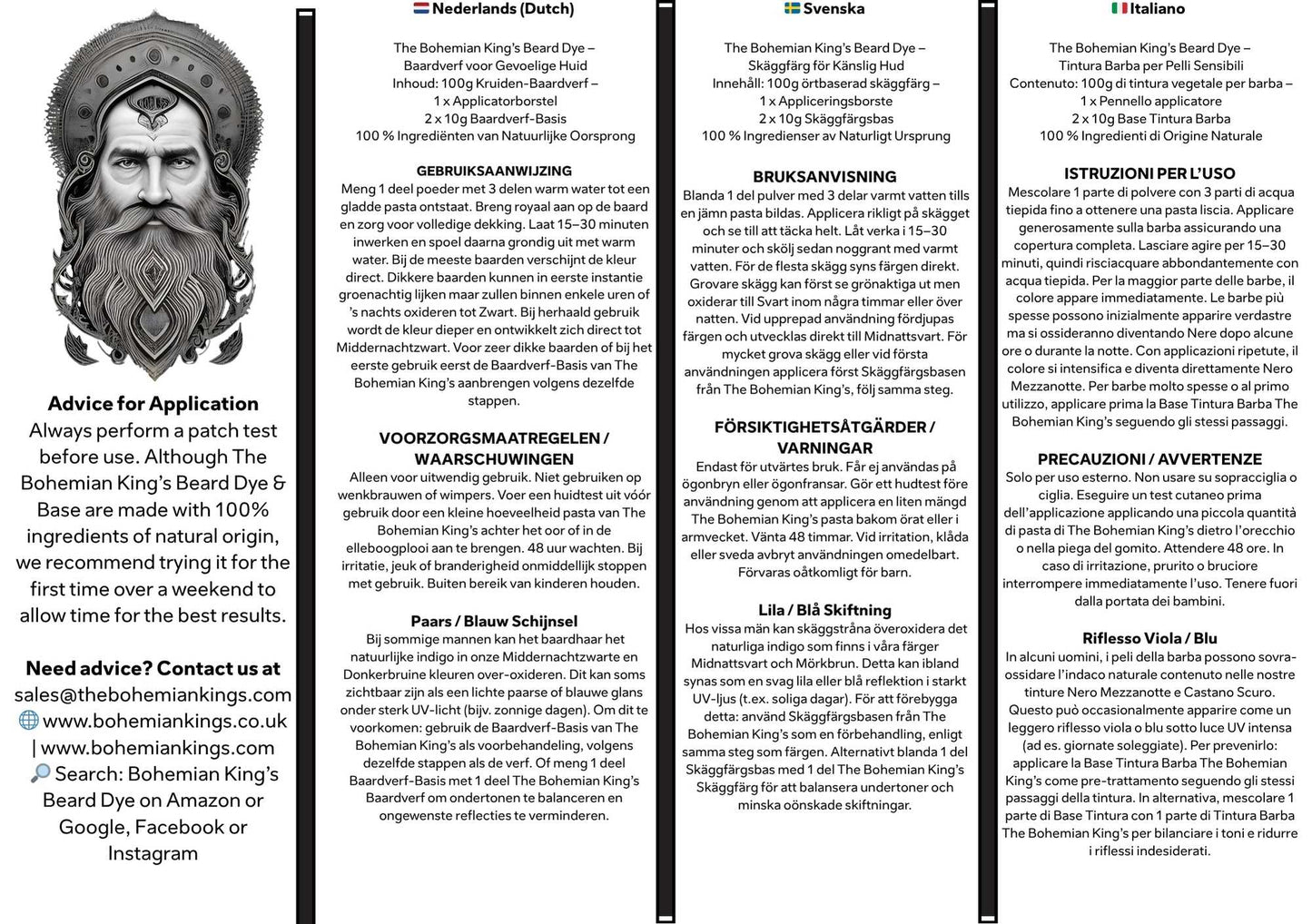
For the complete method, use our step-by-step beard dye application guide.
Step 4: if the colour remains obviously wrong, cleanse before adding colour
Once the normal colour-development period has passed, a wash can help remove colour sitting more loosely on the surface of the beard.
For a pronounced unwanted purple or blue result, our troubleshooting approach may include a cleansing wash before considering another colour application.
Do not scrub aggressively and do not immediately follow the wash with layer after layer of darker dye.
Let the beard dry and reassess it.
If you are using The Bohemian King’s and are unsure about the result, contact us with photographs taken in daylight before carrying out a corrective application.
That is much easier to troubleshoot than trying to repair several additional layers of colour.
What if the beard is simply too dark?
Again: do not immediately put another shade over it.
A plant-based dark result can soften as the beard is washed and as the initial appearance settles.
Give the colour time.
If you used Midnight Black on a naturally brown beard, the more important lesson may be shade choice rather than application technique.
Our rule is to choose colour according to the remaining natural facial hair, rather than selecting the darkest shade because the beard contains a lot of grey.
Read how to choose beard dye when your beard is going grey before the next application.
What should you change next time?
Do not change five things at once.
That makes it impossible to understand what improved the result.
For a Bohemian Kings user experiencing colour variation, the sensible sequence is:
-
make sure the beard is clean and free from oils or balms
-
use the Beard Dye Colour Base exactly as directed
-
mix using warm water — never boiling
-
apply thoroughly through resistant white areas
-
stay within the recommended application time
-
allow the finished colour to develop before judging it
Where necessary, application time or shade can then be reviewed based on the actual settled result.
Why we use a Colour Base
The Colour Base is included as a preparation stage within The Bohemian King’s system.
It is particularly relevant for men dealing with coarse, resistant or colour-variable grey and white hairs.
It should not be thought of as a guaranteed “purple remover”.
Its purpose is to give the beard a more controlled preparation stage before the main colour.
That distinction matters.
Can boiling water prevent purple beard colour?
No.
Do not use boiling water with The Bohemian King’s plant powders.
Use warm water.
A practical range of approximately 35–70°C gives you plenty of scope to create a smooth, workable paste without resorting to boiling water.
More heat is not automatically more colour.
When should you contact us?
If your beard remains strongly purple, blue, greenish or unexpectedly dark after the development period, send us clear photographs before applying additional colour.
Ideally take:
-
one photograph in natural daylight
-
one close-up of the affected hairs
-
one full-beard photograph
-
a note of the shade used
-
whether Colour Base was used
-
approximate mixing water temperature
-
application time
Those details make useful troubleshooting possible.
The key rule: diagnose before correcting
Unwanted beard colour can often be made worse by treating it as an emergency.
Instead:
let it develop → inspect it properly → identify what happened → then decide what needs changing.
A slightly unusual first result is far easier to work with than three rushed corrective applications.
Related guides
Frequently asked questions
Why did my grey beard turn blue?
Indigo is a blue colourant and very pale hairs can make cool tones more visible. Preparation, formulation, hair type and colour development can all influence the result.
Can indigo turn purple on hair?
Scientific research has demonstrated blue-to-purple colour development on hair treated experimentally with Indigofera tinctoria, associated with indigo and the later formation of indirubin. That does not prove that every purple beard result has exactly the same cause.
Should I put black beard dye over a purple result?
Do not immediately add more dark colour. Allow the original colour to complete its development first and identify the problem before applying another product.
Should I mix beard dye with boiling water?
No. The Bohemian King’s plant-powder colour should be mixed using warm water, not boiling water.